
Questions and answers about GORE-TEX® – washing and care with TexCare
CLICK ON THE QUESTIONS BELOW AND GET THE ANSWERS
How to wash and waterproof GORE-TEX®
It is important to wash your GORE-TEX® when it is dirty. The Gore-Tex® membrane stops working when the microscopic holes in the fabric are blocked by dirt. Use a gentle detergent like TexCare® Woolwash.
If there are stains that you are worried won't come out in the wash, apply TexCare® Stain Remover ½ - 1 hour before washing. This will dissolve the stains without damaging the garment.
Once your GORE-TEX® clothing is dry, it's important to waterproof it. Be careful not to use a waterproofing agent that closes the micro-holes. Waterproofed clothing stays cleaner, dirt rolls off, and the garment's breathability is maintained.
TexCare® Waterproofer is a safe choice that adds an invisible, thin, but strong protective layer over all the fibers.


What is GORE-TEX®?
GORE-TEX® is a so-called PTFE (polytetrafluoroethylene) membrane. The GORE-TEX® material is strong, elastic, and very resistant to various chemicals. Furthermore, it has an extremely low adhesion (everyone knows Teflon's non-stick effect). The membrane is ultra-thin (fractions of a millimeter thick) and it is so-called semi-permeable. The membrane allows water in vapor form, like body sweat, to pass out, while water in droplet form cannot pass in.
This is due to the difference in size: Steam molecules are much smaller than water in droplets.
GORE-TEX® history
The basic material used in both clothing and shoes. The most important ingredient in a GORE-TEX® product, the membrane itself, is often not visible. Nevertheless, it is absolutely crucial for the function. In 1969, Bob Gore invented a way to expand polytetrafluoroethylene into a microporous material. This material, PTFE, turned out to have a completely unique combination of properties. Until then, there were materials that allowed water vapor to pass through, and other materials that were completely waterproof, but no material that had both of these properties. Bob Gore's expanded PTFE membrane is now known under the trademark GORE-TEX®. This material has pores, cavities between the fibers. These cavities are 20,000 times smaller than a drop of water, but 700 times larger than a water vapor molecule. This makes the material completely waterproof, while allowing moisture to escape. In addition, the material has proven to have a whole range of other properties (temperature and chemical resistance, high wear resistance, electrical insulation ability), which means that new applications are still being discovered every day. In order to transfer the unique properties to a jacket or a pair of trousers, the GORE-TEX® membrane is always laminated to one or more layers of fabric. The outermost layer of fabric is often impregnated so that the raindrops bounce off and roll down the surface of the clothing. All seams in GORE-TEX® clothing or shoes are taped with a specially developed super-strong but flexible tape so that they can be completely waterproof. Would you like to know more about the secret behind the GORE-TEX® material?
Then click on www.gore-tex.se
What is the function of GORE-TEX®?
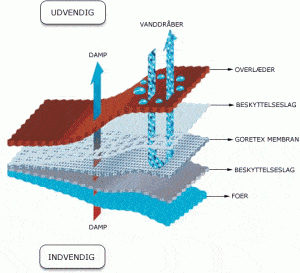 The openings in the membrane are large enough to allow water in vapor form to pass through, but at the same time, the openings are so small that water in droplet form is retained. Vapor molecules are several times smaller than water droplets. Vapor from the inside escapes, but water on the outside stays out, so the footwear is 100% waterproof. The GORE-TEX® function is twofold: The footwear must be 100% waterproof, but the feet must also be able to breathe, i.e., get rid of the vapor that is the result of muscle work in the feet. Moisture from the feet must be able to escape so that the indoor climate remains good. Wet/moist feet are an excellent cold bridge, and cold, clammy feet have caused many sick days before GORE-TEX® was invented. Since active feet excrete surprisingly large amounts of vapor/water (up to a cupful of water a day), something effective must be done.
Where is the membrane located?
The membrane is protected between the upper leather and the lining (see figure 1 above). On both sides of the membrane, both inside and outside, there is a protective layer. These protective layers prevent the membrane from being damaged by wear and tear from the inside and friction from seams, hooks, etc. on the outside of the membrane.
Does GORE-TEX® footwear need to be waterproofed?
The GORE-TEX® membrane as such does not need any form of care, but it is still a good idea to impregnate and care for footwear with a membrane. A brand new shoe/boot should be impregnated a few times before it is used (also under the soles) – regardless of whether it is made of leather, textile or another material. The purpose of the impregnation is not to improve the waterproofness itself – because that is handled by the membrane. The purpose is almost like waxing a car: Properly impregnated, the materials become strongly dirt- and water-repellent.
How do I dry GORE-TEX® footwear?
GORE-TEX® itself is a very stable and strong material that can withstand high temperatures. This means you can dry (children's) boots in a drying cabinet. However, be aware that leather cannot withstand being heated too much, as it will dry out. The best way to dry leather is to take the insoles out of the footwear and, in the good old-fashioned way, dry the boots with newspaper (or kitchen roll) inside – at room temperature. Afterwards, the leather needs new nourishment in the form of care products.
How to care for GORE-TEX® shoes and boots?
The most important rule is not to use silicone-based care products, as these close the membrane and thus the breathability – turning the boot into a non-breathable 'rubber boot'. All the usual care products can be used, but it is important that the declaration on the care product positively indicates that the care product can be used for GORE-TEX®.
ECCO GORE-TEX® boots/shoes are generally made from 3 types of materials:
Smooth leather
Oil nubuck/nubuck
Textile materials
Smooth leather:
Back in the day, before GORE-TEX®, people would heavily waterproof with silicone and apply a thick layer of greasy shoe polish. That's also OK because it protects the leather and makes it almost waterproof. But at the same time, breathability goes out the window, so the feet "boil". Leather grease is therefore not a good idea anymore.
Use TexCare Waterproofer. Also, spray the footwear under the soles. The waterproofing ensures that the leather does not absorb so much water and does not attract as much dirt. Water is also a problem when drying the footwear, because leather that is soaked with water will eventually crack. For daily maintenance: Use shoe polish in the color of the leather. Shoe polish is cosmetic to some extent, but also contains wax, which further protects the footwear and adds grease. TexCare Leather Lotion also adds necessary fats, which prevent the leather from cracking, and is colorless.
Oilnubuck: Waterproof like leather and maintain with a beeswax spray product, e.g. Rustical. (Oilnubuck is leather that has been roughened up and then applied with a thin-bodied, wax-containing grease.)
Nubuck: Waterproof and maintain with TexCare Waterproofer. Roughen up with a suede sponge before waterproofing.
Textiles: TexCare Impregnation spray is used here - also on a daily basis.
How do I care for my GORE-TEX® CLOTHING?
Don't be afraid to wash your GORE-TEX® clothing. The garment's function, comfort and lifespan will only improve by washing it when needed.
Always re-impregnate after washing.
Wash and dry clean with TexCare
As a general rule, you should follow the washing instructions on the garment. Most clothes can be machine washed at 40°C. Use a mild detergent and avoid using fabric softener or bleach. It's a good idea to rinse the clothes several times. If you need to remove stubborn stains, use TexCare Stain Remover. You should always test the colorfastness of the fabric in an inconspicuous area first. Always re-impregnate after washing.
Waterproof your Goretex with TexCare Water Repellent
After each wash and long-term use, we recommend that you re-impregnate the garment. The GORE-TEX® membrane remains completely waterproof, but the impregnation helps the garment's outer layer to repel dirt and water. TexCare® Impregnation is ideal.
How do I care for my GORE-TEX® SHOES?
Wash the shoes in lukewarm water, and use a brush if needed if they are very dirty. Let the shoes dry at room temperature. Leather shoes should be sprayed with TexCare Impregnation, which repels dirt and water. Then apply shoe cream, or TexCare Leatherlotion. The leather remains soft and supple without the pores being covered, thus reducing breathability.
